
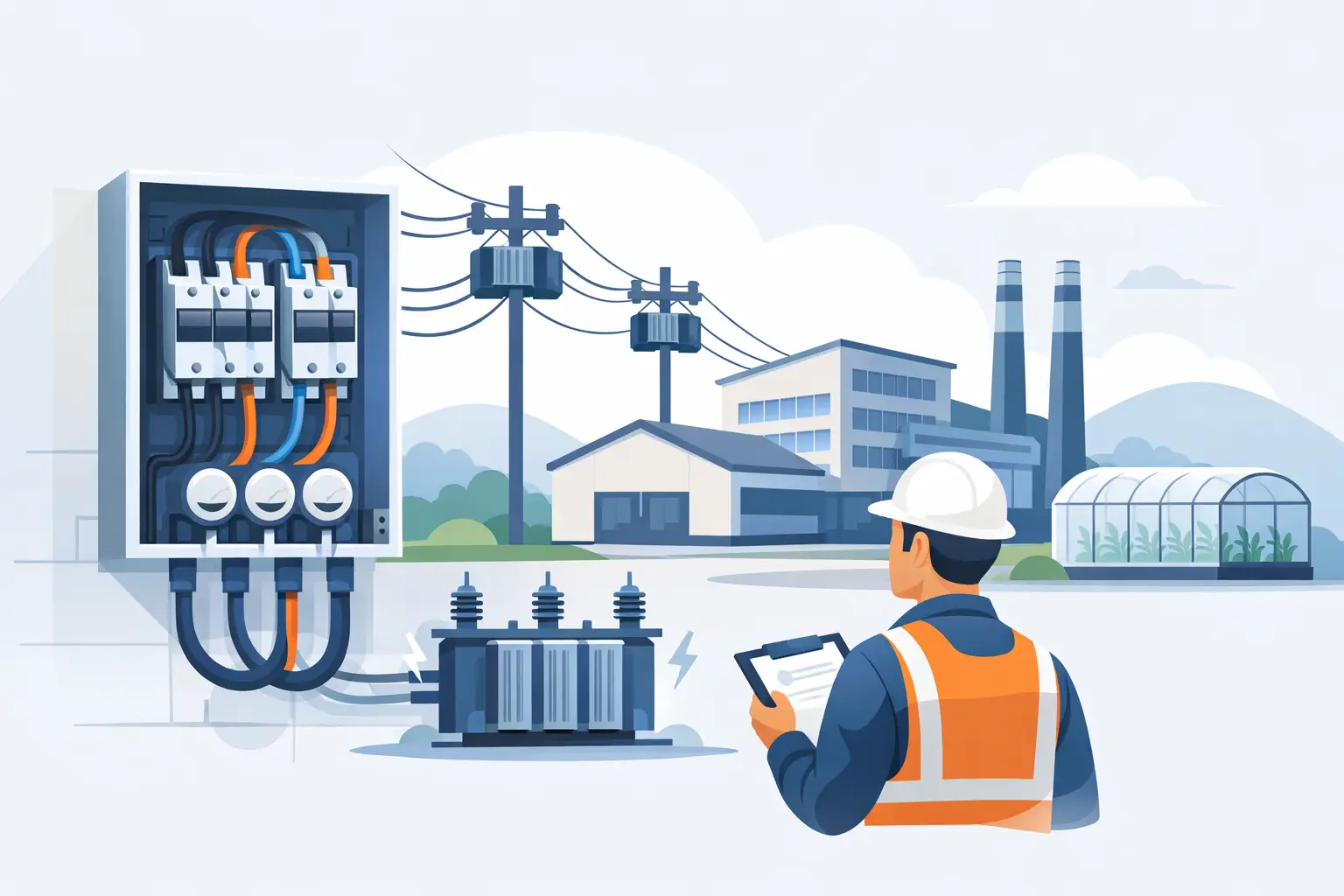
A workshop that keeps tripping when machinery starts, an office block adding EV chargers, or a self-build with a large heat pump can all reach the same point: single-phase supply is no longer enough. A three phase installation provides greater electrical capacity and a more balanced way to run demanding equipment, but it needs to be planned around the building, its future use and the incoming supply.
For businesses, developers and homeowners across Norwich, Norfolk and East Anglia, the right approach is not simply to install a larger consumer unit. It is to establish what power is available from the network, what the site genuinely needs and how the installation can remain safe, compliant and practical for years to come.
What is a three phase installation?
Most homes in the UK have a single-phase electricity supply. This delivers 230 volts and is suitable for normal domestic loads such as lighting, sockets, appliances and many smaller heat pumps or EV chargers.
A three-phase supply has three live conductors, each offset from the others, alongside neutral and earth conductors where required. It provides around 400 volts between phases and 230 volts between any phase and neutral. The benefit is not that every circuit operates at a higher voltage. Rather, the available load can be shared across three phases, allowing the installation to support higher-demand equipment efficiently.
In commercial and industrial settings, three phase is common. Motors, compressors, pumps, machinery, commercial kitchens, larger HVAC equipment and production equipment often rely on it. It can also make sense in larger homes where several significant electrical loads are expected at once, particularly where the property is being designed for electrification from the outset.
When is three phase worth considering?
The answer depends on maximum demand, not just the number of electrical items in a building. A property may have extensive lighting and sockets but still operate comfortably on single phase. Conversely, a modest workshop may need three phase because one piece of machinery has a high starting current or requires a three-phase motor.
For a new-build home, it is sensible to consider the likely combination of a heat pump, induction cooking, electric vehicle charging, solar PV battery storage, hot tub, pool equipment and outbuildings. Not all of these will run at full output together, so a competent designer applies diversity rather than simply adding up every rating. However, an installation with little spare capacity can become expensive and disruptive to alter later.
For commercial premises, warning signs include repeated tripping under normal use, equipment that cannot be connected without limiting other loads, plans for additional production machinery, or a requirement for three-phase motors. Landlords and developers should also think beyond the first tenant. A suitable three-phase infrastructure can make a unit more flexible and attractive to future occupiers.
EV charging is a common reason to review supply capacity. A three-phase charger can charge compatible vehicles more quickly where the vehicle, charger and supply allow it. That does not mean every home needs three phase for an electric car. A well-designed single-phase charging arrangement is often entirely appropriate. The decision should reflect present demand, future plans and the cost of upgrading the incoming supply.
The first question: what does the network provide?
A three-phase distribution board cannot create a three-phase supply. Before design work begins, the incoming service and cut-out need to be checked. Some sites already have three phase available but only use one phase internally. Others have a single-phase connection and require an upgrade from the local Distribution Network Operator, often called the DNO.
The DNO assesses whether its local network can provide the requested capacity. Depending on the site, this may be straightforward, or it may require new cabling, excavation, network reinforcement or a contribution towards the cost. Timescales and charges vary considerably, which is why early enquiries matter on new builds, conversions and commercial projects.
The position of the service head, meter and main distribution equipment also needs attention. Three-phase metering and switchgear take up more space than a basic domestic arrangement. In a tight utility cupboard or retail back room, access, fire separation, ventilation and future maintenance can all affect the final layout.
Designing a three phase installation properly
Once the incoming supply is confirmed, the installation should be designed from the load profile backwards. This starts with a clear schedule of equipment, its rated power, starting characteristics, expected operating times and any manufacturer requirements.
Load balancing matters
A major advantage of three phase is the ability to distribute single-phase circuits across the three phases. Lighting, socket circuits, kitchen loads, office areas and small power can be allocated to keep demand reasonably balanced. Perfect balance is rarely possible because actual use changes throughout the day, but significant imbalance can place unnecessary demand on one phase and the neutral conductor.
Dedicated three-phase loads, such as a motor or commercial heat pump, are connected across all three phases. These need correct protection, cable selection and isolation. Motor loads may also need suitable starting methods, controls or variable-speed drives to manage inrush current and operational performance.
Distribution, protection and isolation
A three-phase board must be selected for the environment and anticipated fault level. Industrial units may require metal-clad distribution equipment, trunking, containment and clearly labelled local isolators. A premium home may need a neater, more discreet arrangement, while still allowing enough capacity for solar, battery storage, heat pumps and charging equipment.
Protective devices are not chosen by rating alone. Their type, breaking capacity, discrimination with upstream devices, cable route and the nature of the connected load all matter. RCD protection must also be considered carefully, especially where chargers, inverters, drives or other electronic equipment may introduce DC residual currents. Manufacturer instructions and current wiring requirements must be followed.
Safe isolation is particularly important on three-phase equipment. Isolators must disconnect all live conductors as required, be accessible to those who need to use them and be clearly labelled. A poorly marked installation creates unnecessary risk for staff, tenants and anyone carrying out maintenance later.
Allow for the next stage
Good electrical design creates sensible spare capacity without overspending on equipment that will never be used. This might mean spare ways in a distribution board, containment sized for additional cables, a route to an outbuilding, or provision for future PV and battery connections.
For solar PV systems, three phase can offer useful flexibility, particularly on larger properties and commercial sites. The inverter arrangement, export limitation, battery operation and phase balancing need to be considered together. A battery does not automatically support every phase in the same way during a power cut, so resilience expectations should be discussed at the design stage rather than assumed.
Safety, testing and certification
Three-phase systems carry greater fault energy and may remain energised on other phases even when part of the installation has been isolated. This is not work for informal alterations or assumptions based on a single-phase board. Correct identification, isolation procedures, testing and documentation are essential.
On completion, a new installation or significant alteration should be inspected and tested. The appropriate electrical certification records the work carried out and the test results. Commercial clients should retain drawings, circuit schedules and equipment information as part of their building records, particularly where facilities teams, tenants or contractors will need to manage the installation.
Existing premises also benefit from periodic inspection and testing. An Electrical Installation Condition Report, or EICR, can identify deterioration, unsuitable alterations, overloaded circuits, missing labels and issues with protective measures. For landlords, businesses and duty holders, this is a practical way to understand the condition of an installation before expansion plans turn a minor issue into downtime.
What affects the cost?
There is no useful one-price answer for a three-phase upgrade. The cost is influenced by whether three phase is already at the property, the DNO’s requirements, cable distances, groundworks, metering changes, board size, containment, connected equipment and the complexity of testing and commissioning.
A small internal conversion at a site with an existing three-phase service is very different from bringing a new supply into a rural development or upgrading a busy manufacturing unit while production continues. Phasing the work can sometimes reduce disruption, but it must be planned carefully so temporary arrangements remain safe and compliant.
The cheapest quote is rarely the best measure of value. A design that overlooks future loads, leaves no cable routes or fails to coordinate with builders, heating engineers and renewable installers can cost far more to correct later. Clear scope, proper load calculations and an agreed plan for shutdowns are usually worth more than a headline figure.
Choosing the right installer
Look for an electrical contractor that is comfortable with both the technical detail and the wider project. Three-phase work often sits alongside structural coordination, machinery requirements, EV charging, heating, solar PV and ongoing inspection obligations. Those connections should be considered before cables are installed, not after walls are closed up.
Elite Electrical works across domestic, commercial and industrial projects, from high-specification new builds to factory environments. The aim is straightforward: build an installation around how the property will actually be used, then leave it properly tested, labelled and ready for what comes next.
If you are planning new equipment, a development or a major electrical upgrade, start the conversation while layouts and service routes can still be changed. Early planning gives you more options, fewer compromises and an electrical supply that supports the way your property is growing.